24/7 Emergency Plumber Serving Kenilworth
Big Blue Plumbing delivers emergency plumbing across Kenilworth and the wider Sunshine Coast, Noosa, and Moreton Bay regions, with immediate dispatch for urgent jobs and 24/7 availability. The team is licensed, carries Public Liability and Workers Compensation insurance (Public Liability covers accidental property damage during work; Workers Compensation relates to workplace injuries on the job), and has 40+ years of combined plumbing experience across 3,000+ completed jobs. Emergency response covers accessible faults where the plumber can isolate the risk, assess the fault, and restore safe operation; if diagnostics point to concealed damage or major replacement work, the options are explained and a flat-rate quote is provided once scope is confirmed.
Kenilworth sits between the Mary River valley and Conondale National Park hinterland, with a mix of older character homes built in earlier decades and newer rural residential properties. Plumbing faults in the area often reflect property age and water source type—older homes may still have galvanised or copper pipework susceptible to corrosion or joint failure, while properties on rainwater tanks face different pressure and sediment issues compared to mains-fed systems.
Dispatch for Kenilworth originates from our Sunshine Coast base. Arrival timing depends on current bookings, traffic conditions, and the location within the service area, but urgent work is prioritised and an ETA is provided when you book. For after-hours callouts, the nearest available technician is allocated to minimise wait time while maintaining safety and proper resourcing.
What Counts as an Emergency and What Happens Next
An emergency plumbing situation is one where there's an active safety risk, ongoing property damage, or a complete loss of essential services like water supply or sewage function. Burst pipes spraying water, gas leaks with a distinct odour, a blocked sewer backing up into the home, or a hot water unit leaking heavily onto electrical circuits all qualify as urgent.
When you contact us, the starting point is confirming what's happening and whether there's an immediate action you can take to reduce harm, turning off the water at the meter, isolating a leaking fixture, or ventilating a space if gas is suspected. We don't coach step-by-step troubleshooting over the phone. If the situation is urgent, we dispatch a licensed plumber and provide an ETA based on current job load and your location.
On arrival, the plumber confirms access, identifies the fault location, and isolates the impacted area to make it safe. Assessment involves checking the visible pipework, testing pressure where relevant, and using diagnostic tools like thermal imaging or moisture meters when a leak is suspected but not visible. Once the fault is identified and the scope is clear, you're given a fixed-price quote before any repair work starts.
If the fault can be resolved on the first visit, replacing a failed flexi hose, clearing a blockage, or re-seating a leaking valve, the work is completed, tested, and verified before the plumber leaves. If the issue requires parts not carried on the van, structural access, or follow-up work, the immediate priority is making it safe (capping a line, temporary isolation, installing a bypass), then scheduling the full repair once you've confirmed the quote and any required parts are sourced.
Common Emergency Situations We Handle
The most frequent emergency service calls in residential properties involve water escaping where it shouldn't or essential services suddenly stopping. Here's what we typically see:
- Burst Pipes: Sudden pipe failure due to corrosion, ground movement, or high pressure. Copper pipes corrode at joins over time; PVC can crack if struck or if bedding shifts. Water sprays under mains pressure until isolated.
- Flexi Hose Failure: Braided flexi hoses connecting taps or toilets can burst without warning, often due to age or poor installation. The flow is high-volume and continues until the isolation valve or mains is shut off.
- Gas Leaks: Detected by the added mercaptan smell (rotten egg odour), hissing sounds near appliances, or dying vegetation over underground lines. All gas work requires a licensed gas fitter and a pressure test after repair.
- Blocked Sewers: A main sewer blockage causes wastewater to back up into floor waste, showers, or toilets. It's often linked to tree root intrusion in clay or terracotta lines, or to Fat, Oil, and Grease (FOG) buildup in kitchen waste lines.
- Hot Water System Failure: Loss of hot water can be urgent in winter or for households with young children. Electric storage systems often fail due to element burnout or thermostat faults; gas continuous flow units may have ignition or burner issues. Leaking hot water tanks require immediate isolation to prevent scalding risk or water damage.
For older Kenilworth homes with original pipework, corrosion-related failures become more likely as the system ages. Properties relying on rainwater tanks may experience pressure fluctuations or sediment-related blockages in fixtures, which don't always present as urgent but can escalate if left unaddressed.
How Emergency Dispatch and Pricing Work
Big Blue Plumbing prices work by the job, not by the hour. Once the plumber has assessed the fault and confirmed what's involved, you receive a fixed-price quote covering labour, materials, and the completed repair. You decide whether to proceed once you know the full cost. There are no surprise add-ons or incremental hourly charges during the work.
For after-hours or weekend callouts, confirm the call-out fee status when you book. Some emergency situations attract a call-out fee to cover dispatch and initial attendance; this is explained upfront so there's no ambiguity. If the call-out fee applies and you proceed with the quoted work, the fee structure is clarified before the plumber is dispatched.
We also offer a senior discount (show your senior card) and a 0% interest payment plan via Brighte, with approval typically completed in 5, 7 minutes. Both options are available for emergency and non-urgent work, and the plumber can confirm eligibility and process the payment plan onsite if needed.
The fixed-price model removes timing uncertainty. You're not watching the clock while the plumber works, and the quote doesn't change if the repair takes longer than expected (provided the scope remains the same). If additional faults are discovered during the work, they're scoped separately, quoted, and only proceeded with if you approve the additional cost.
What the First Visit Involves and How Outcomes Are Verified
The first visit focuses on three things: making the situation safe, identifying the cause, and confirming the scope so accurate pricing can be provided.
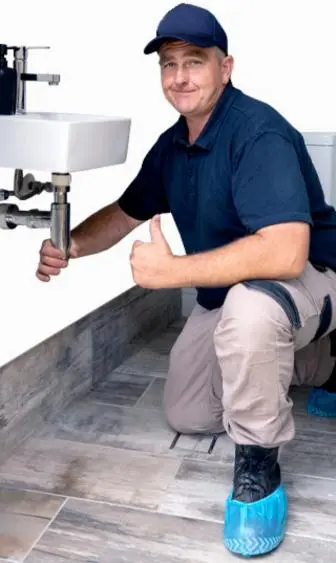
The attending plumber arrives in uniform, confirms identity, and explains what they'll be checking before starting. If the property has restricted access, narrow driveways, or specific entry requirements, let us know when booking so approach and parking can be planned accordingly. Drop sheets or protective coverings are used in work areas, and boot covers are worn in occupied homes when requested or when site conditions require it.
For ruptured pipes or leaks, the plumber isolates the affected section, traces the leak to its source (using moisture detection tools if it's concealed), and confirms whether it's a localised failure or part of a broader issue with the line. For blockages, initial inspection identifies whether the restriction is in an accessible trap, further down the line, or in the main sewer. High-definition CCTV check equipment may be used to visually locate blockages, identify root intrusion, or assess pipe condition without excavation.
Gas leak investigations involve pressure testing the system after any repair to ensure it's gas-tight and safe to recommission. Hot water faults are diagnosed by checking element function (electric systems), burner operation and ignition (gas systems), or thermostat and pressure relief valve condition (all types). If a component has failed, the replacement is quoted; if the unit is beyond economical repair, replacement options are explained with pricing for comparable models.
Once the work is completed, the plumber tests and verifies the outcome, confirming flow is restored after a blockage is cleared, checking pressure after a pipe repair, or running a hot water system through a full cycle to confirm it's heating correctly and holding temperature. The work area is cleaned, rubbish and old parts are removed, and you're walked through what was done and what to expect going forward.
What's Covered by the Workmanship Warranty
All completed work is backed by our workmanship warranty, which covers the quality and durability of the labour and installation we perform. If a fault develops in the workmanship, a join that leaks, a fixture that loosens, or a component that fails due to how it was installed, it's addressed under the warranty at no additional cost.
The warranty does not cover wear and tear on the parts themselves (that's handled by the manufacturer's warranty on the specific product), damage caused by misuse, or new faults unrelated to the original repair. If something does go wrong and you're not sure whether it's related to the previous work, call us. We'd rather check it and confirm than have you second-guess whether it's covered.
For emergency work completed under time pressure, the same warranty applies. The aim is always a durable fix, not a temporary patch that fails in a few weeks.
Why Licensing, Insurance, and Experience Matter in Emergency Situations
Emergency plumbing work carries higher risk than scheduled maintenance. You're often dealing with active leaks, pressurised water, gas systems, or electrical components in close proximity to water. The combination of urgency and complexity is why licensing, insurance, and verified experience matter.
All technicians attending your property are appropriately licensed for the plumbing, drainage, and gas work they perform (where required by regulation). Gas work must be completed by a licensed and fully insured gas fitter, and a compliance certificate is issued for regulated installations to verify the work meets Australian Standards (AS/NZS 5601.1 for gas).
Our Public Liability insurance provides protection if accidental property damage occurs during the work, if a tool slips and cracks a tile, or if water damage results from an unforeseen issue during repair. Workers Compensation insurance relates to workplace injuries sustained by our team on the job. Both coverages are in place for your protection and ours.
Beyond the paperwork, experience changes how quickly a fault can be diagnosed and resolved. With 40+ years of combined plumbing experience across the team and 3,000+ jobs completed, the plumber attending your emergency has likely seen the same fault in comparable properties before. That pattern recognition speeds up diagnosis and reduces the chance of misidentifying the cause or missing a secondary issue that could trigger another callout.
From jobs around the Sunshine Coast and hinterland areas, we've noticed that properties built in the 1970s, 1980s often have copper hot and cold lines with compression fittings that corrode at the join. Newer estates tend to use PEX or modern PVC, but installation quality varies depending on the builder. Older rural homes in the Kenilworth area may have mixed systems, part original galvanised, part retrofitted copper or plastic, which complicates tracing and isolation when a fault occurs.
Identity, Safety Checks, and Professional Conduct
Every attending technician has completed police checks and background screening as part of our employment process. When a plumber arrives, they'll identify themselves, confirm the job details, and explain what they'll be doing before entering the property. If you've requested specific entry protocols, confirming identity at the door, calling ahead, or working within a restricted timeframe, let us know when booking so those instructions are noted and followed.
Inside occupied homes, we isolate the work area where practical, keep noise and disruption as low as possible, and treat finished surfaces (stone benchtops, tiled bathrooms, timber floors) with care. The work area is kept tidy throughout the job, not just at the end, and all rubbish generated by the work is removed when the plumber leaves.
For security-sensitive or premium-finish homes, the scope is confirmed before touching visible fixtures, and any movement through the property is minimised and respectful. If there are specific concerns or requests, protecting a particular surface, working around pets, or coordinating with other trades onsite, mention them when booking so the plumber is prepared.
Local Context: Why Property Type and Water Source Affect Emergency Response
Kenilworth's mix of older character homes and newer rural residential builds means the plumbing systems vary significantly by property age and water source. That context affects what faults we commonly see, how they present, and what the repair involves.
Older homes, particularly those built before the 1980s, often retain original galvanised steel or early copper pipework. Galvanised pipe corrodes from the inside out over decades, narrowing the bore and eventually leading to pinhole leaks or complete joint failure. Copper pipes in the same era often used compression fittings that weaken as the copper oxidises, especially in areas with acidic or mineral-heavy water.
Properties relying on rainwater tanks face different issues. Tank water often carries fine sediment that can block tap aerators, shower heads, or toilet inlet valves. Pressure fluctuations are common if the tank level drops or if the pump cycles on and off under load. If a rainwater-fed system loses pressure suddenly, the fault could be at the pump, the pressure switch, a split in the delivery line, or a blockage at the tank outlet, all of which require different diagnostic approaches.
Mains-fed properties on town water experience higher and more consistent pressure, which places greater stress on fixtures, flexi hoses, and pipe joins. Bursts in mains-fed systems tend to be higher volume and cause more immediate damage compared to tank-fed systems, where pressure drops as soon as the pump is isolated.
For blocked drains in older Kenilworth properties, tree root intrusion is a frequent cause, particularly in clay or terracotta sewer lines. Roots follow moisture and enter through microscopic cracks, then expand and trap debris. The result is a slow drain that eventually backs up completely. High-pressure water jetting clears the roots and scours the line, but if the pipe structure is compromised, replacement or relining may be recommended to prevent recurrence.
Strata, Rental Properties, and Commercial Emergency Work
Emergency plumbing assistance in strata, rental, or commercial properties often involves additional coordination around access, responsibility boundaries, and documentation.
For strata properties, it's important to confirm whether the fault is in a lot (owner responsibility) or in common property (body corporate responsibility). A leaking tap or fixture inside the unit is typically the owner's responsibility; a burst pipe in a shared wall or a sewer blockage in the main line is usually common property. If you're unsure, we can assess the location and advise, but final responsibility determination sits with the strata manager or body corporate.
Rental properties require clear communication with tenants, agents, and landlords. If the tenant contacts us directly, we confirm who is authorising the work and provide documentation (photos, scope description, invoice) suitable for lodging with the agent or landlord. For urgent faults posing a safety risk or causing property damage, we can attend and make it safe, then provide a detailed report and quote for the landlord or agent to approve before completing the full repair.
Commercial emergency work often occurs outside business hours to minimise downtime. We can follow site induction requirements, sign-in procedures, and work around operational constraints where disclosed. Documentation is provided for maintenance logs, compliance records, and insurance claims if required.
How to Reduce Risk While Waiting for the Plumber
If you're dealing with an active leak, gas smell, or sewer backup, there are a few immediate actions that reduce harm without requiring you to diagnose the fault or attempt a repair.
For water leaks, turn off the water supply at the meter or isolation valve closest to the fault. If it's a leaking tap or toilet, the isolation valve is usually under the fixture. If it's a ruptured pipe and you can't isolate locally, turn off the mains at the meter (typically located at the front boundary). Once isolated, open a tap downstream to release residual pressure.
If you smell gas, a distinctive rotten egg odour, do not operate electrical switches, ignition sources, or anything that could create a spark. Ventilate the area by opening windows and doors, turn off the gas at the meter if you can access it safely, and call us immediately. Do not attempt to locate the leak yourself or use a flame to test for gas presence.
For sewer blockages backing up into the home, stop using water in the affected area (toilets, sinks, showers) until the blockage is cleared. Using more water will worsen the backup. If it's already flooded, isolate the area to prevent contamination spreading to other rooms, and avoid contact with the wastewater.
These steps make the situation safer and limit damage while the plumber is on the way, but they're not a substitute for professional assessment and repair. We'll confirm the cause, restore safe operation, and verify the system is working correctly before we leave.
What Affects Emergency Response Timing and After-Hours Availability
Big Blue Plumbing operates 24/7 for emergency plumbing across the Sunshine Coast, Noosa, and Moreton Bay regions, including Kenilworth. Urgent jobs are prioritised and dispatched first, with the nearest available technician allocated based on location, current job load, and the type of fault.
Timing varies depending on several factors. If multiple emergencies are in progress, the most urgent (active gas leak, major flooding, sewage backup) takes priority. Distance from the dispatch base and current traffic conditions also affect arrival time, particularly for locations in the Kenilworth hinterland where access involves winding roads and limited alternative routes.
When you call, we provide an estimated arrival time based on current dispatch status. If delays occur, another job runs longer than expected, or weather affects travel time, we update you without delay so you're not left waiting without information.
After-hours availability means a plumber is on call overnight, on weekends, and on public holidays. It doesn't mean every job receives an instant response; resourcing and scheduling still apply. But it does mean that if you have a genuine emergency at 2 a.m. On a Sunday, someone will answer, assess the urgency, and dispatch a licensed plumbing technician to make it safe and restore function.